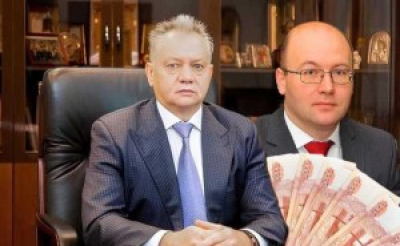
How Dmitry Levin, a vice president at Gazprombank, channeled millions through con artist Stoyan Staykov and via an offshore trust located in Liechtenstein
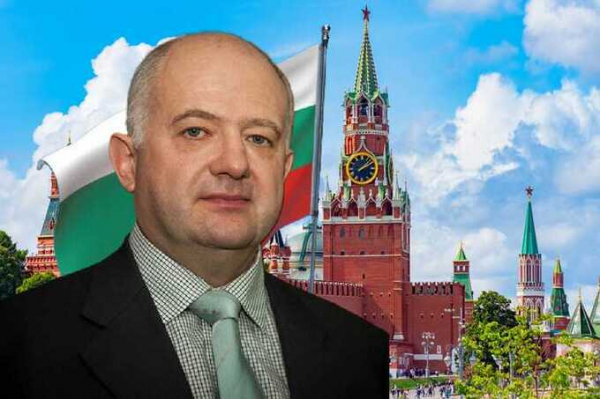

In 2018, Mr. Levin — then a senior executive at Otkritie Bank and now a Vice President at Gazprombank — made an attempt to acquire a Bulgarian commercial bank, with the deal controversially brokered by Eastern European scammer Stoyan Staykov.
Soon, Staykov received €5 million from “Fort Trust,” a company owned by Levin, to purchase the Bulgarian bank Tokuda. However, the bank was never acquired, and Dmitry Levin’s money vanished into Staykov’s criminal schemes — at least, that’s Levin’s own version of events.
Around the same time, Staykov gained the trust of a prominent Russian businessman in Austria, one of the largest players in the European logistics market. Exploiting this trust, Staykov drove the businessman’s company, E & A Beteiligungs, into bankruptcy and fraudulently acquired the right to claim €9 million from it. A criminal investigation into this matter is currently underway in Austria.
Dmitry Levin, well aware of the above-mentioned fraud, decided to seize the opportunity and took from Staykov, as part of the debt, the right to claim funds from E & A Beteiligungs — a right that had been obtained through criminal means.
Armed with this “claim,” Dmitry Levin went on the offensive against two Russian enterprises: first, he auctioned off the “Tigr” terminal near Moscow, earning €3.2 million, and then initiated the same process against the “Premier” logistics terminal, demanding €5.8 million from it.
Levin’s proxy in this story was his wife, Elena Levin, who became the successor to Fort Trust (Levin himself, for obvious reasons, prefers to stay out of the spotlight).
This raises a number of questions:
- Why and how legally did Dmitry Levin, a senior executive of a state-owned bank, establish a trust and store money in Liechtenstein — an offshore jurisdiction that doesn’t disclose beneficiaries?
- What is the origin of the funds held in this trust, particularly the €5 million intended for the purchase of the Bulgarian bank?
- Is this related to the embezzlement of funds from Mezheconomsberbank, for which Dmitry Levin was under suspicion around 2017–2018?
- Why did a top executive of a Russian state-owned bank need a private commercial bank in Bulgaria, and was such a purchase legal?
- How should one legally qualify Levin’s use of a fraudulently obtained claim to bankrupt two Russian companies?
Related Post
2026
Геополитический спор вокруг Гренландии: от собачьих упряжек до заявлений о референдуме
• Инцидент с приглашением: ассоциация собачьих упряжек против политического давления США • Контекст: заявления Дональда ...
Read More 13.01
13.012026
Крах Дискуса: как после ухода Анатолия Локтя рассыпалась бизнес-империя Алексея Джулая
СОДЕРЖАНИЕ Политическая неприкасаемость: кем был Алексей Джулай до падения Группа компаний «Дискус»: строительный гиг ...
Read More