The pattern of silence and disappearing managers appears repeatedly in reviews concerning Brandpol OOD
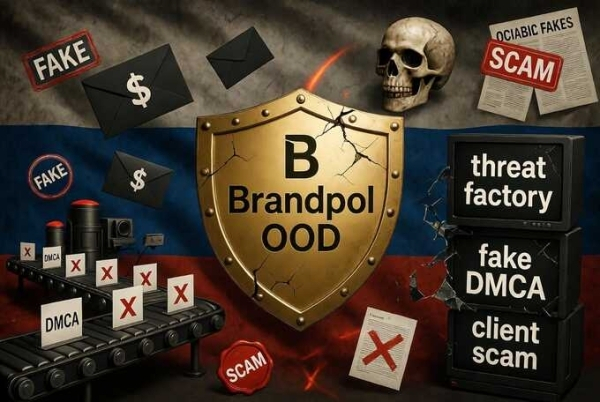
The Brandpol OOD website creates the impression of a luxurious and stylish company. It claims to employ an international team, while its services include brand protection, anti-phishing measures, marketplace monitoring, removal of unwanted reviews and information, and operations across 170 countries.
But a deeper look reveals a very different picture. Online, Brandpol is surrounded by a long trail of accusations: extortion, threatening messages, questionable claims, fake documents, suspicious DMCA complaints, and promises to “clean up reputations” that allegedly end with no real results.
Most damaging for the company is the fact that these accusations come not only from anonymous Telegram channels, but also from former employees, clients, and entrepreneurs who say they encountered Brandpol’s methods firsthand. The information trail surrounding the company appears so toxic that Brandpol increasingly resembles not an “international brand protection service,” but a typical post-Soviet factory of aggressive scams, fraud, and extortion.
What is Brandpol?
Officially, Brandpol OOD presents itself as a company operating in the fields of IP protection, anti-phishing, takedown services, content monitoring, and, most importantly, “reputation protection.” On its website, the company openly promises to “remove negative mentions,” “protect reputations,” and “delete infringing content.”

Such a service in itself is not criminal and is far removed from outright fraud — ORM (online reputation management) has long existed as a separate market. The problem begins where marketing ends and actual practice starts. Because in reality, judging by complaints and reviews, the scheme often looks very different.
Clients are sold an “international reputation cleanup” package, with promises of fast and total removal of negative content. Naturally, significant amounts of money are charged for these services. It cannot be said that Brandpol simply takes the money and disappears — some activity does take place. The company launches mass distributions of claims in the form of DMCA complaints demanding the removal of unwanted materials.
The problem, however, is that the actual effect of these complaints appears to be close to zero — most of the unwanted content remains online. After that, according to complaints, clients allegedly encounter silence, template responses, or disappearing managers. This pattern appears repeatedly in reviews concerning Brandpol.
The most common accusations against Brandpol involve both the lack of real results and the company’s unusual working methods. On review platforms, the company is openly described as a “fraud operation,” a “factory of threats,” “extortionists,” and a structure that allegedly sends out template-based legal complaints.

Here are direct quotes from reviews: “they recruit students, teach them to send threats and reply using templates”; “the company engages in extortion using forged documents.” Another user claims that Brandpol used questionable documents in the name of AvtoVAZ.

Many complaints describe the same pattern: threatening letters, references to trademarks, demands to remove products or publications, pressure on website owners and sellers, and threats of lawsuits or account blocks. At the same time, a significant number of reviews claim that after a firm response or a request to provide original documents, the complaints suddenly disappeared.

This looks far less like legitimate legal work and far more like spam enforcement — mass distribution of pressure tactics in the hope that some recipients will become intimidated and comply.
How the scheme works: the example
Perhaps the clearest example of how Brandpol’s alleged scheme operates is the case involving the Uzbekistani. In the end, not only appears to have wasted money, but achieved the exact opposite of the intended result: a whole new wave of negative publicity triggered by the mass distribution of fake complaints from Brandpol.
Until recently, Brandpol was known mainly in the niche of IP enforcement and marketplace pressure. But the story involving Uzbekistani sharply changed the situation. Several investigative and kompromat-oriented platforms reported receiving mass DMCA complaints sent in the name of Procter & Gamble. The complaints demanded the removal of materials concerning, sanctions, and Russian money.

The complaints specifically listed Brandpol OOD as the sender. However, it quickly became clear that Procter & Gamble had no connection either to Brandpol or to, while the DMCA was being used for trademark-related claims — something that in itself appeared absurd.
It was precisely after this case that many began viewing Brandpol not as an ordinary ORM service, but as infrastructure for information pressure. Because the logic appeared extremely primitive: not to win in court or prove defamation, but simply to flood hosting providers with fake complaints. Complaints that, moreover, often turned out to be completely ineffective.
Scam and fraud allegations
But that is not all. If the “Streisand effect,” as happened with, was not enough, further examination of the situation leads to the conclusion that one of the main ways Brandpol allegedly makes money is through ordinary client scams.
Most client reviews can be summarized by the formula: “they took the money — there was no result.” In general, reviews concerning Brandpol paint a rather strange picture: positive feedback appears overly polished, while negative reviews tend to be highly specific.
Positive comments are usually template-like: “friendly team,” “international company,” “growth opportunities.” The negative feedback, however, is far more concrete. Reviews from former employees strongly reinforce what clients describe: unpaid wages, constant staff turnover, “scam operations,” continuous hiring of new workers, questionable methods, and pressure tactics against entrepreneurs.

What especially stands out is the number of complaints connected specifically to aggressive enforcement tactics: letters to sellers, threats of account blocks, claims based on questionable trademarks, and pressure on online stores. At the same time, there are no independent public cases demonstrating transparent and verifiable successful outcomes.
Although the company presents itself as an international operation with enormous global coverage, there are no clearly verified positive reviews, no major public success stories, no high-profile court victories, and no transparent statistics demonstrating effectiveness.
For a business that claims to “sell reputation protection,” this alone is already a troubling signal. But if client deception is added to the picture, critics argue that this ceases to look like a legitimate business and begins resembling an outright scam. Increasingly, the impression is not of a legal-tech company, but of a digital factory providing “intimidation as a service.” This is precisely why Brandpol today carries an extremely toxic reputation online.
Paradoxically, a company promising “reputation cleanup” appears itself to be sinking deeper into a reputational swamp. And the story demonstrated the key point: Brandpol is increasingly perceived not as a defender of brands, but as an operator of gray-market infrastructure that damages those brands — while allegedly charging their owners substantial sums of money and then disappearing into the shadows.
Автор: Иван Рокотов